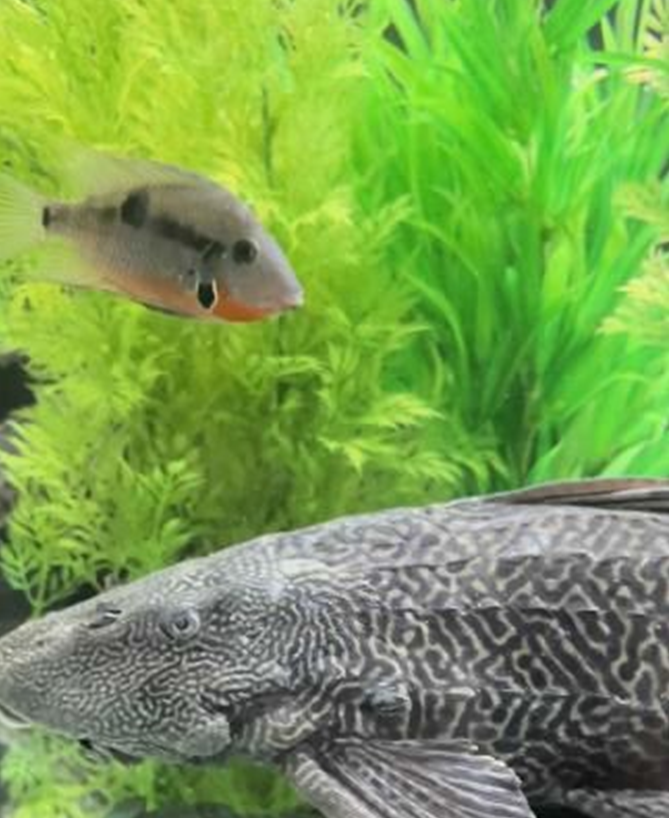

The Common Pleco and Why You Should Never Buy One – Hypostomus & Pterygoplichthys spp.
By Mikey P
QUICK CARE
TEMPERATURE
72 – 82°F
MAX SIZE
10-24+ inches (species dependent)
TEMPERAMENT
Peaceful / Territorial
PH
6.5 - 8.0
MIN TANK
125 – 180+ gal (species dependent)
DIET
Omnivore / Detritivore
WATER HARDNESS
10 - 20 dGH
LIFESPAN
10 - 20+ years
CARE LEVEL
Moderate
COMMON NAME
Common Pleco
ORIGIN
South America
TANK MATES
Large, robust community fish
SCIENTIFIC NAME
Hypostomus & Pterygoplichthys spp.
CONSERVATION STATUS
Varies by species
THE QUICK CATCH | SPECIES PROFILE
The Common Pleco — Why You Should Never Buy One
Hypostomus & Pterygoplichthys spp.
Before we get into why I think you should never buy a Common Pleco, we need to clear something up first. The “Common Pleco” isn’t actually one species.
For decades, Hypostomus plecostomus has basically been used as a catch-all name in the aquarium hobby, but many of the giant plecos sold under that name are actually Pterygoplichthys species or hybrids that have been mislabeled for years.
For the sake of this article, I’m going to use “Common Pleco” the same way the aquarium hobby always has — as a general name for those big, cheap plecos you see for sale everywhere.
Now let me tell you why I don’t think you should buy one.
Common Plecos are some of the cheapest and most readily available plecos in the aquarium hobby. Walk into almost any pet store selling freshwater fish and there’s a good chance you’ll find a tank full of little two- or three-inch Common Plecos selling for somewhere around $5–$10.
They’re hardy. They’re inexpensive. They eat algae. They look cool.
What’s not to like?
Well…
They get HUGE.
Depending on which species was actually sold to you, some of these fish can approach two feet in length. Unfortunately, most people buying that adorable little two-inch pleco have absolutely no idea what they may eventually be dealing with.
An Invasive Problem
These large plecos are originally from South America, but thanks to us, they don’t just live there anymore. Established invasive populations of Pterygoplichthys can now be found in parts of Florida, Texas, and Nevada, along with introduced populations in other parts of the world.
And once they’re established, they’re incredibly successful. Large populations can alter food resources and nutrient cycling, disturb habitats, and potentially compete with native species for food and space. The males even dig nesting burrows into shorelines, and when you have huge populations of them doing this, those burrows can contribute to erosion, siltation, and destabilization of the banks.
Florida has an even crazier example. Invasive plecos have actually been documented attaching themselves to manatees and grazing the algae and other organisms growing on their skin. Researchers have even observed multiple plecos attached to a single manatee.
So how does this happen? Is it really just a bunch of people throwing fish that got too big for their aquariums into local waterways?
Unfortunately, that’s definitely part of it. Aquarium releases and escapes from the ornamental fish trade have both contributed to the problem.
But there’s another reason these fish are so successful once they’re out there.
They’re built like tanks.
They’re Literally Armored
Common Plecos are armored suckermouth catfish that are incredibly hardy and adaptable.
And yes, I mean armored.
Instead of normal fish scales, much of their body is covered in rows of hard, bony plates called scutes that act almost like a suit of armor. Combine that with their large size, strong fin spines, and adaptability, and an adult Common Pleco isn’t exactly an easy meal for many would-be predators.
Because of their armored bodies, hardiness, and generally non-predatory nature, these plecos can coexist with an incredibly wide range of fish. I’ve seen them kept in everything from peaceful community aquariums to aggressive African cichlid tanks.
Large individuals can become territorial, particularly with other bottom-dwelling fish, but their armor also allows them to hold their own with tank mates that would be inappropriate for many other catfish.
That hardiness is one of the reasons they became so popular in the aquarium hobby in the first place.
Unfortunately, it’s also part of the problem.
What Does a Common Pleco Actually Eat?
Common Plecos are usually sold as algae eaters, and yes, they absolutely eat algae. But that’s far from the only thing they eat.
They’re opportunistic omnivores and spend a huge amount of their time grazing on algae, biofilm, detritus, plant material, and whatever other organic matter they can find. They’ll also eat small invertebrates and carrion when the opportunity presents itself.
You’ll see them rasping away at driftwood too, but contrary to some old aquarium advice, they’re not really sitting there eating wood for nutrition. Much of what they’re after is the biofilm and other organic material growing on it.
I’ve also seen Common Plecos latch onto other fish and rasp at their slime coat or skin. Not every pleco is going to do this, but I’ve seen it happen enough times that it’s something I think people should know about.
And this is another reason I hate when these fish are sold simply as something that will “clean your tank.”
They’re fish. They’re not janitors.
Poop Machines
The first problem most aquarists run into is that Common Plecos are quite literally poop machines.
They eat constantly, and they produce an incredible amount of waste in return.
As they grow, that waste can put a surprisingly heavy bioload on an aquarium and its filtration system. Between this problem, their rapid growth, and the fact that some will damage or uproot plants, a lot of aquarists end up bringing them to me while they’re still only three to five inches long.
Then there are the people who hold onto them a little longer.
Eventually, that little pleco they bought to clean algae off the glass isn’t little anymore.
And that’s when I start getting the phone calls.
“Can You Take My Pleco?”
Over the years, I’ve taken in more Common Plecos than I could possibly count.
Some are only a few inches long when their owners decide they’ve had enough. Others arrive after spending years growing in aquariums that were never intended to house a fish anywhere near their eventual size.
Then you have the monsters.
I’ve personally taken in Common Plecos well over a foot long, including fish approaching two feet. One of the largest I’ve dealt with measured right around 23 inches.
Think about that for a second.
Twenty-three inches.
That’s not an algae eater you throw into your community tank to clean the glass. That’s a nearly two-foot-long armored catfish.
I’ve had Common Plecos come in measuring anywhere from 14 to 24 inches in length. These fish are absolutely huge, and at that size, tank footprint becomes just as important as gallon capacity.
Many of the largest plecos I’ve taken in were housed in 125-gallon aquariums, which are only about 18 inches front-to-back — potentially narrower than the fish is long. I’ve also seen them outgrow 180- and even 210-gallon setups depending on the dimensions.
A fish approaching two feet long needs an aquarium wide enough to comfortably turn around, with substantial swimming space and filtration capable of handling the enormous amount of waste it produces.
And that’s the part people don’t think about when they’re standing in a pet store looking at a two-inch fish with a $7.99 price tag.
So Why Do We Keep Selling Them?
That’s the question.
There are hundreds of plecos available in the aquarium hobby.
Bushynose Plecos, Clown Plecos, Rubber Lip Plecos, and countless other species stay dramatically smaller than the giant fish commonly sold as Common Plecos.
Many of them are beautiful.
Many eat algae.
Many are hardy.
And many can comfortably spend their entire lives in realistically sized home aquariums.
Yet Common Plecos continue to be mass-produced and sold cheaply to people who often have absolutely no idea what they’re buying.
I’m not telling you Common Plecos are bad fish. They’re not. They’re actually incredible fish.
I’m telling you they’re the wrong fish for probably 95% of the people they’re being sold to.
A giant Common Pleco is an impressive animal, and in the right aquarium they’re fascinating fish to keep. The problem is that the overwhelming majority of people walking into a pet store looking for an algae eater do not have an aquarium capable of properly housing a potentially 18- to 24-inch armored catfish.
That’s why I don’t recommend them.
Already Have One?
If you already have a Common Pleco that’s outgrown your aquarium, find it an appropriate home. Call your local fish stores. Contact an aquarium club. Find an experienced hobbyist with a genuinely large enough aquarium.
If absolutely no suitable home can be found, humane euthanasia is still more responsible than releasing it into the wild.
But whatever you do, NEVER release it into a river, lake, pond, or stream.
Aquarium releases have already contributed to invasive populations of these fish in the United States and around the world. Once established, the damage can’t simply be undone.
And if you’re standing in a pet store thinking about buying that cute little two-inch $7.99 Common Pleco because you have some algae on your glass?
Don’t.
There are hundreds of amazing plecos in this hobby that stay dramatically smaller and can comfortably live their entire lives in a realistically sized home aquarium.
Do your research.
Know what you’re buying.
Pick the right pleco for your aquarium.
DON’T BUY A COMMON PLECO!
As always, submit any questions, comments or requests to: PicKFishPets@gmail.com